
June 8, 1867 – April 9, 1959
Frank Lloyd Wright revolutionized architecture through his vision of organic design that harmonized human spaces with their natural environment. Born in Wisconsin shortly after the Civil War, he developed a distinctly American architectural style that broke free from – hand to ch- traditions. His philosophy of organic architecture emphasized the integration of form and function, creating spaces that flowed naturally from and into their surroundings.
Wright’s career spanned seven decades, during which he designed over 1,000 structures, with 532 being completed. His masterpieces include Fallingwater in Pennsylvania, the Guggenheim Museum in New York, and the Imperial Hotel in Tokyo. Each project showcased his innovative use of materials, spatial relationships, and his commitment to what he called “breaking the box” of traditional architecture.
Beyond his architectural achievements, Wright was also an educator, writer, and philosopher who established the Taliesin Fellowship, training young architects in his principles of organic architecture. His influence extended beyond buildings to furniture design, stained glass, and even urban planning through his concept of Broadacre City.
Despite personal controversies and financial difficulties throughout his career, Wright’s genius for integrating nature, art, and human needs transformed our understanding of what architecture could be. His work continues to inspire architects and designers who seek to create harmony between human habitation and the natural world.
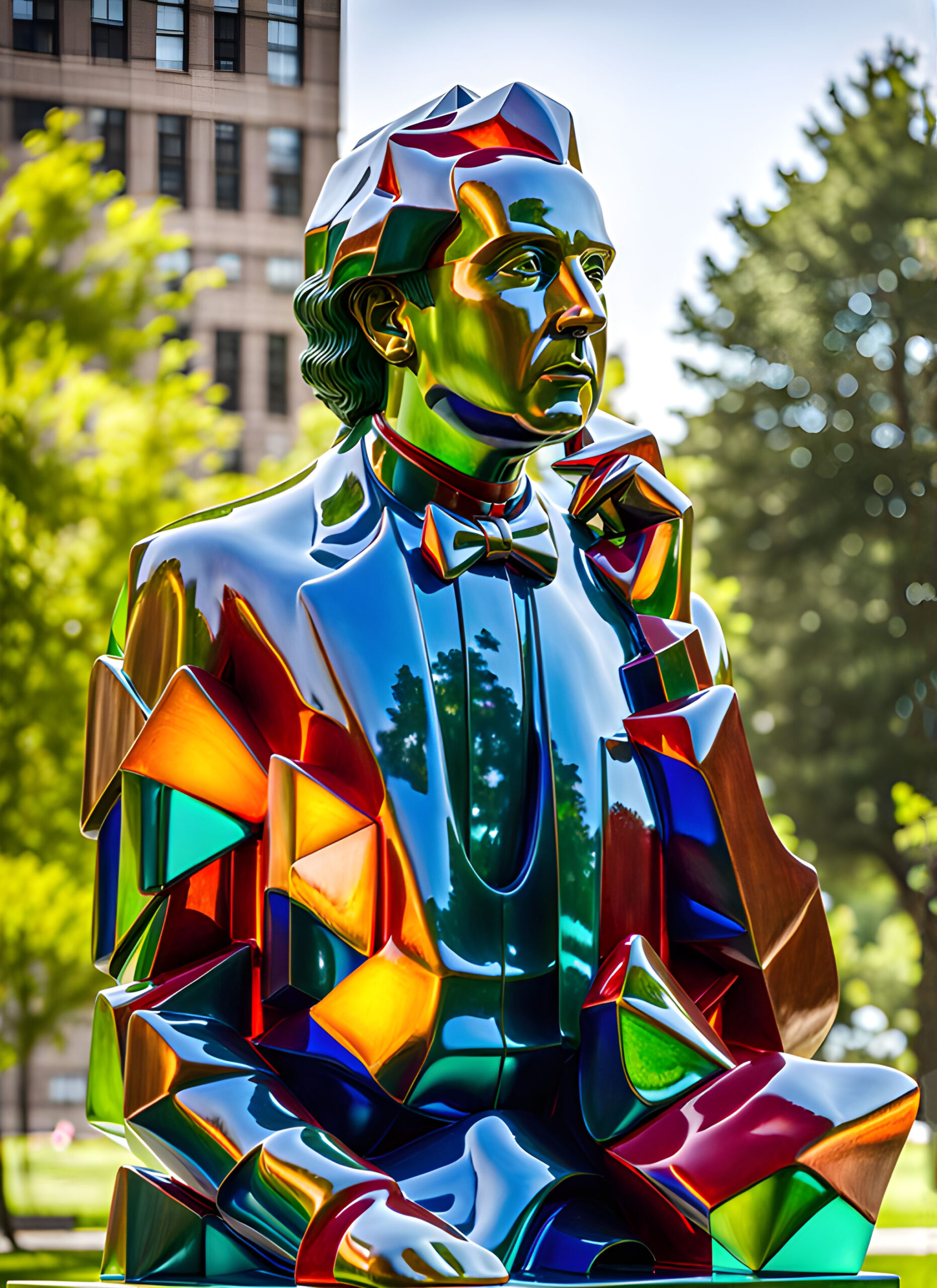
Frank Lloyd Wright’s Statue
The statue is a striking modernist interpretation rendered in highly polished, multi-faceted glass surfaces that create a kaleidoscope of colors. The geometric planes and angles of the piece mirror Wright’s own architectural style, while the reflective surfaces capture and transform surrounding light and nature – a fitting tribute to his organic architecture philosophy. The figure shows Wright in his characteristic bow tie and formal attire, hand thoughtfully placed at his chin, suggesting both the contemplative nature of his work and his role as a visionary thinker. Set in an urban green space with buildings visible in the background, the statue creates a dialogue between nature and architecture that Wright himself championed throughout his career.
More Thinkers to Explore

Muhammad Ali

Maya Lin

John Lennon