
December 22, 1960 – August 12, 1988
Jean-Michel Basquiat exploded onto the New York art scene like a supernova, transforming from a street artist known as SAMO into one of the most influential artists of the 20th century. Rising from spray-painting enigmatic epigrams on Manhattan walls, he created a revolutionary artistic language that combined pop culture, African American history, and searing social commentary.
Starting as a homeless teenager selling hand-painted postcards, Basquiat’s meteoric rise to art world stardom by his early twenties was unprecedented. His raw, neo-expressionist style incorporated crowns, copyright symbols, anatomical drawings, and cryptic text that addressed everything from racism and colonialism to consumer culture and class struggle. His friendship and collaboration with Andy Warhol became legendary, though it also highlighted the art world’s complex relationship with race and authenticity.
Basquiat’s work challenged the establishment not just through its content but through its very existence in elite galleries and museums. As a young Black artist, his presence in these traditionally white spaces was itself a form of protest. His paintings, often selling for millions even during his lifetime, forced the art world to confront its own biases about who could be considered a “serious” artist.
His tragic death at 27 from a heroin overdose cut short a revolutionary career, but his influence continues to grow. Today, his works command some of the highest prices in the art market, with paintings selling for over $110 million. More importantly, his artistic legacy has opened doors for generations of artists of color and continues to inspire conversations about art, race, and power in America.
Jean-Michel Basquiat’s Statue
The statue captures Basquiat in vibrant cobalt blue, wearing his signature crown; a recurring symbol in his work that represented both dignity and the weight of expectation. Cast in an angular, neo-expressionist style that mirrors his artistic aesthetic, the figure shows him in deep contemplation. The surface is decorated with fragments of text and symbols reminiscent of his paintings, creating a three-dimensional interpretation of his distinctive visual language. Set within a gallery space with arched ceilings, the statue’s dramatic color and geometric forms create a powerful contrast with the classical architecture, much as Basquiat’s work challenged traditional artistic conventions.
More Thinkers to Explore
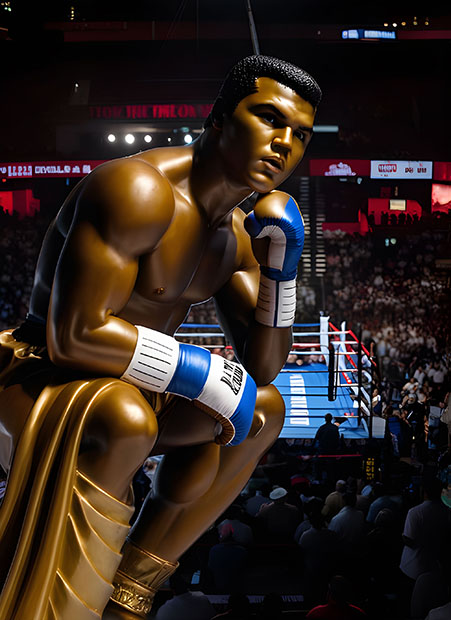
Muhammad Ali

Maya Lin

John Lennon