
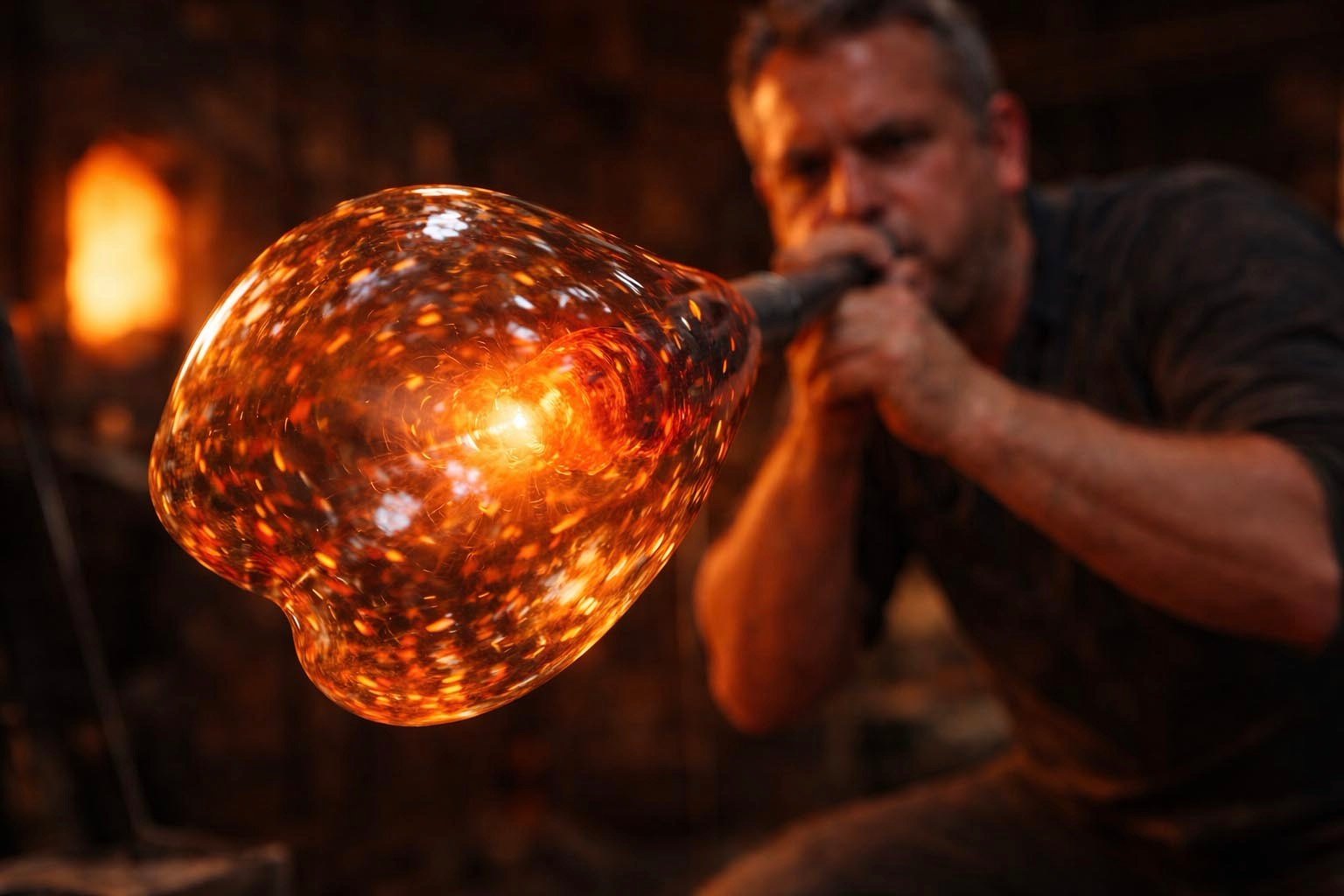
Glass wasn’t always ordinary.
In ancient Egypt, it was as precious as gems. Making it required the right mix of rare materials, extreme heat, and years of apprenticeship. Everyone knew it was hard, and that is why it had value.
Today, you flip a factory switch and glass appears. Cheap. Uniform. Abundant. So abundant that you are more annoyed at having to clean up broken glass than worrying about the money lost. Glassmaking knowledge didn’t vanish. It moved into systems. A world inconceivable to the master craftsmen of the pharaohs.
The same is true for many things. Over and over again, humans mistake current difficulty for permanent limitation. When something requires years of training, we assume it always will. When expertise is scarce, we assume it must remain scarce. When a process feels irreducibly complex, or irreducibly human, we promote that feeling into a law of nature.
People are now doing this with AI.
I keep seeing people confidently say what AI “can’t” do. Not as a current limitation, but as a permanent hard stop. Most of these claims aren’t knowledge. They’re guesses dressed up as certainty.
We’ve seen this before. Even the smartest and most well-educated people fall into the trap. One of the most famous examples comes from the 1890s, when Baron Kelvin of Largs—the President of the Royal Society, the highest scientific title in the world at that time, and one of the leading physicists of his age—publicly argued that heavier-than-air flight was impossible. In 1903, a couple of bicycle mechanics proved him wrong.
This doesn’t mean AI has no limits. Everything does.
This doesn’t mean that every concern about AI is irrational. Many are quite rational.
It means betting against what AI cannot do, forever, isn’t a wise bet. Even the people closest to the technology don’t know the future. They only know what’s hard right now. What they do not know—and cannot know—is how systems will change once constraints shift, tools combine, or entirely new approaches appear. They don’t know what bicycle mechanics are waiting in the wings to change their current beliefs.
Glass became ordinary when skill moved into infrastructure, and no one, in any position, should assume that their expertise will never be automated. That only a human can do X.
The wisest position is not optimism or pessimism, but humility. History does not reward confidence about the future nearly as often as it punishes it.







Leave a Reply